
Can we make a difference?
Dr. Naseemah Mohamed ’08 returned to Portsmouth Abbey to explore education, conflict, and the meaning of freedom.
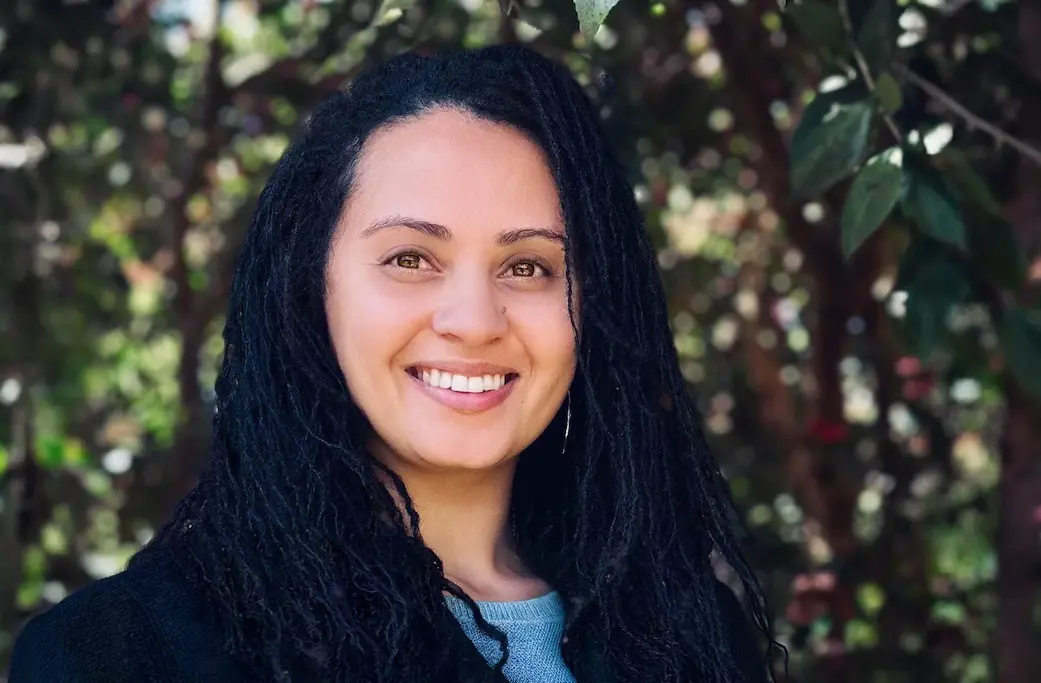
Founded in honor of the late Dom Luke Childs, a Portsmouth Abbey monk and history teacher who valued intellectual inquiry and educational discourse, the Dom Luke Childs Lecture brings scholars and thinkers to campus to engage the community in questions of lasting significance.
During Reunion Weekend, Portsmouth Abbey School welcomed back one of its own. Dr. Naseemah Mohamed ’08, a Rhodes Scholar and an assistant professor at The Carter G. Woodson Institute for African American Studies at the University of Virginia, returned to campus to deliver her lecture, “Can We Make a Difference? Education and the Question of Political, Individual, and Spiritual Freedom,” during Friday’s assembly. Her scholarship explores education and conflict from a global perspective, particularly how schooling is shaped by war, displacement, and political struggle. Her current book project examines how Zimbabwe’s liberation movement used education as a political, ideological, and military tool during the country’s struggle for independence from the Rhodesian regime.
The questions explored in the lecture began during her time at Portsmouth Abbey, as a student, she helped start the Human Rights Club in 2005, beginning a process of questioning the relationships among justice, human rights, religion, politics, and freedom. Those questions followed her into her academic career.
In the lecture, Dr. Mohamed turned to the history of Zimbabwe, then known as Southern Rhodesia and later Rhodesia, to examine how education can serve both power and resistance. She discussed the role of Cecil John Rhodes and the systems of treaties, taxation, currency, and Western education used to establish colonial control, yet education could also become a means of liberation. Dr. Mohamed spent ten years interviewing veterans of Zimbabwe’s independence movement and learned how some brought children across the border to Botswana to receive an education outside the colonial system, hoping to preserve their culture and sustain the movement for independence. Her research revealed the tension at the center of her lecture: education can be deployed to impose a worldview, but it can also give people the tools to question one.
Studying colonialism and the role of Christianity in history gave Dr. Mohamed new depth to questions she had begun asking at Portsmouth Abbey. Her Benedictine education gave her a foundation for examining the relationship between religious doctrine and the political uses of religion, drawing on traditions such as St. Augustine’s just war theory. Rather than offering simple answers, the Abbey gave her a place to wrestle with complex questions and approach them from multiple perspectives, a foundation that continues to shape her work today.
Over time, her own history became intertwined with the subject of her research. As a Rhodes Scholar at the University of Oxford, Dr. Mohamed was studying the legacy of Cecil John Rhodes while also carrying his name through the scholarship itself. That connection gave her another way to engage with the history she was studying, not by standing outside of it, but by asking what it means to inherit a complicated past and what can be done with it.
The connection became even more personal when she discovered that her great-great-grandmother, Elizabeth Bennet, a washerwoman in Cape Town, had worked as a nanny for the children of lawyers associated with Rhodes, the same legal world involved in creating treaties that shaped the history she was researching.
By the conclusion of the lecture, Dr. Mohamed returned to the question at its center: What is freedom? Initially, she understood it primarily in external terms, as political independence, self-determination, and liberation from oppressive systems. Over time, however, her research led her to consider how freedom can also be cultivated within the individual.
She began interviewing people not only about political history, but also about spirituality. Working with Indigenous knowledge makers, she explored how education and spiritual life shape an individual’s understanding of freedom. That work eventually brought her to Kerala Kalamandalam, a center for traditional Indian performing arts, where the close relationship between teacher and student reminded her of Portsmouth Abbey. Through these experiences, she came to see freedom as something more expansive than political independence. It can also be cultivated within a person through education, reflection, faith, and an understanding of one's place in the world.
For Dr. Mohamed, the answer to whether we can make a difference begins with the questions we are willing to ask, and the education that gives us the courage and knowledge to pursue them.
Those questions first took shape at Portsmouth Abbey.