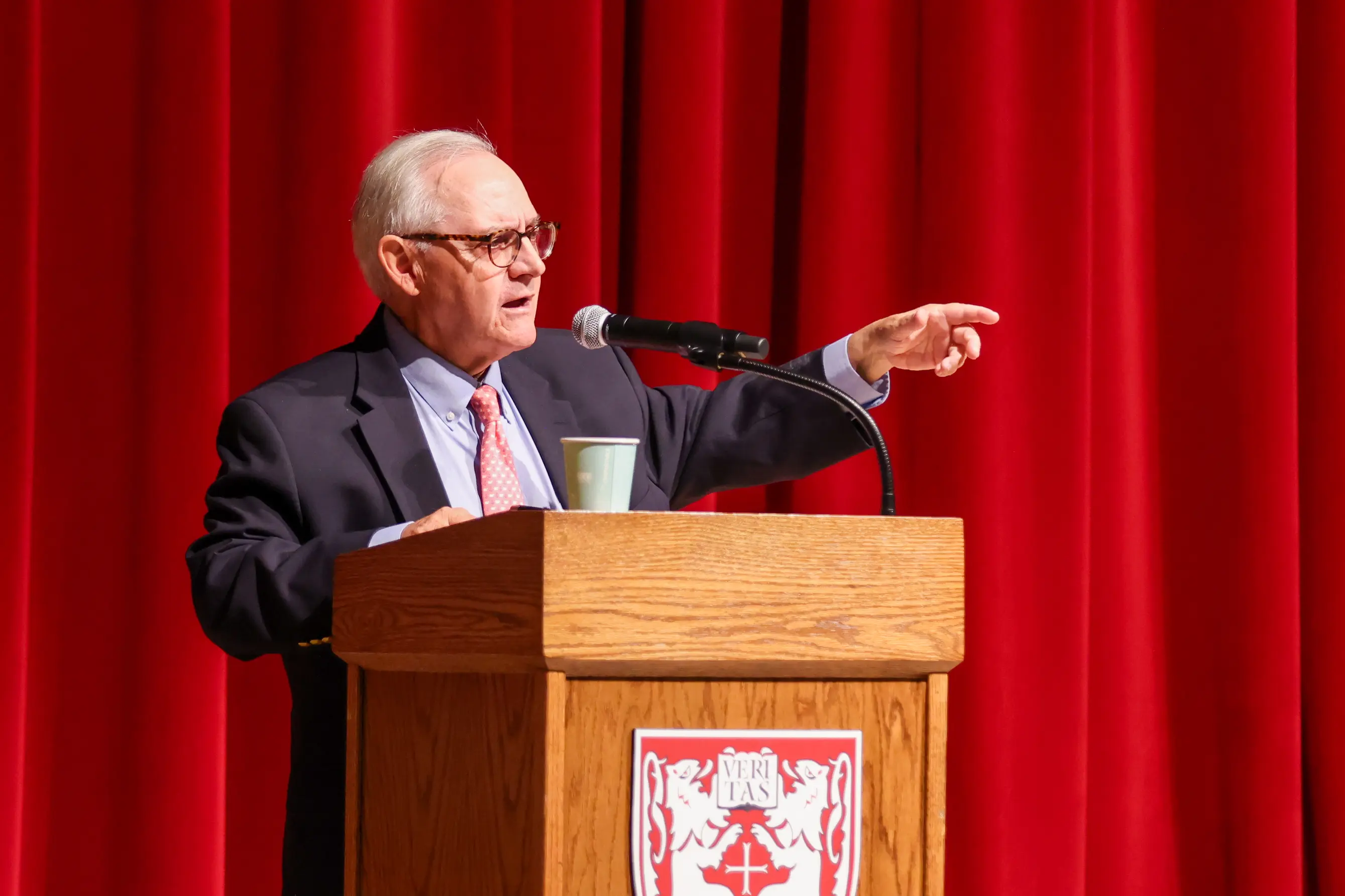
Established in 1976 by Seton J. Shanley, the Mother Elizabeth Seton Lecture brings distinguished speakers to campus to address topics related to American history and politics. The inaugural Seton Lecture was delivered in 1978 by U.S. Senator Eugene McCarthy. Over the years, the series has welcomed notable voices including Pulitzer Prize-winning historian Gordon Wood, author Nathaniel Philbrick and former U.S. Ambassador to South Korea Donald Gregg. Dionne's return added another meaningful chapter to this longstanding tradition.
For Dionne, returning to Portsmouth Abbey was an opportunity to reflect on the education and Benedictine formation that helped shape his intellectual and moral outlook. He spoke about the lasting influence of the School's teachers and monastic community, whose emphasis on critical thinking, reflection, faith and responsibility to others provided a foundation that extended well beyond the classroom. Those principles, he explained, have remained central to his understanding of citizenship, public service and the obligations individuals have to one another. His reflections offered a compelling example of how a Portsmouth Abbey education can shape not only what students know, but how they think, engage with the world and contribute to it.
Drawing on the legacy of Dr. Martin Luther King Jr. and the Second Vatican Council, Dionne emphasized that meaningful traditions must remain open to reflection, renewal and change. He encouraged students to look beyond familiar quotations from King's “I Have a Dream” speech and consider its deeper message: America must continually work to fulfill the promises of its founding ideals.
His analyses also extended to the challenges facing today's world, including immigration, economic inequality, war and peace and artificial intelligence. Discussing Pope Leo XIV's approach to technology, Dionne highlighted an important principle: technology is never neutral. “Its impact reflects the values and intentions of the people who develop, finance, regulate and use it.” For students preparing to enter an increasingly complex world, this is a reminder that progress must be accompanied by ethical responsibility.
Throughout the lecture, Dionne returned to a message that resonated particularly with the students in attendance: individuals have a responsibility to stand up for what they believe is right, even when doing so means standing alone. Reflecting on former Senator Eugene McCarthy’saddress Dionne recalled the slogan from McCarthy's presidential campaign: "He stood up alone and something happened."
Students had the opportunity to ask Dionne questions and connect the lecture to their own experience. The challenges facing their generation, the divisions in American society and uncertainty about the future. They were questions about the world these students will soon help lead. Dionne's message was not to give in to cynicism or accept polarization as inevitable. Rather, he urged them to see themselves as participants in shaping what comes next. Disagreement, he reminded them, is a necessary part of democracy, but it should bring people together around the work of solving problems rather than drive them further apart.
In conclusion, Dionne returned to the teachings of St. Benedict: "It is time now for us to rise from sleep." Connecting this call to action with the Benedictine understanding that work itself can be a form of prayer, he encouraged the Portsmouth Abbey community to continue to rise above disconnection and cynicism and embrace the work that democracy and human dignity demand.
For an alumnus whose own journey began in the classrooms and community of Portsmouth Abbey, it was a fitting message to leave behind. And for the next generation of Ravens, it was a reminder that the values learned here are not meant to remain within the walls of the school. They are meant to be carried into the world.
|